
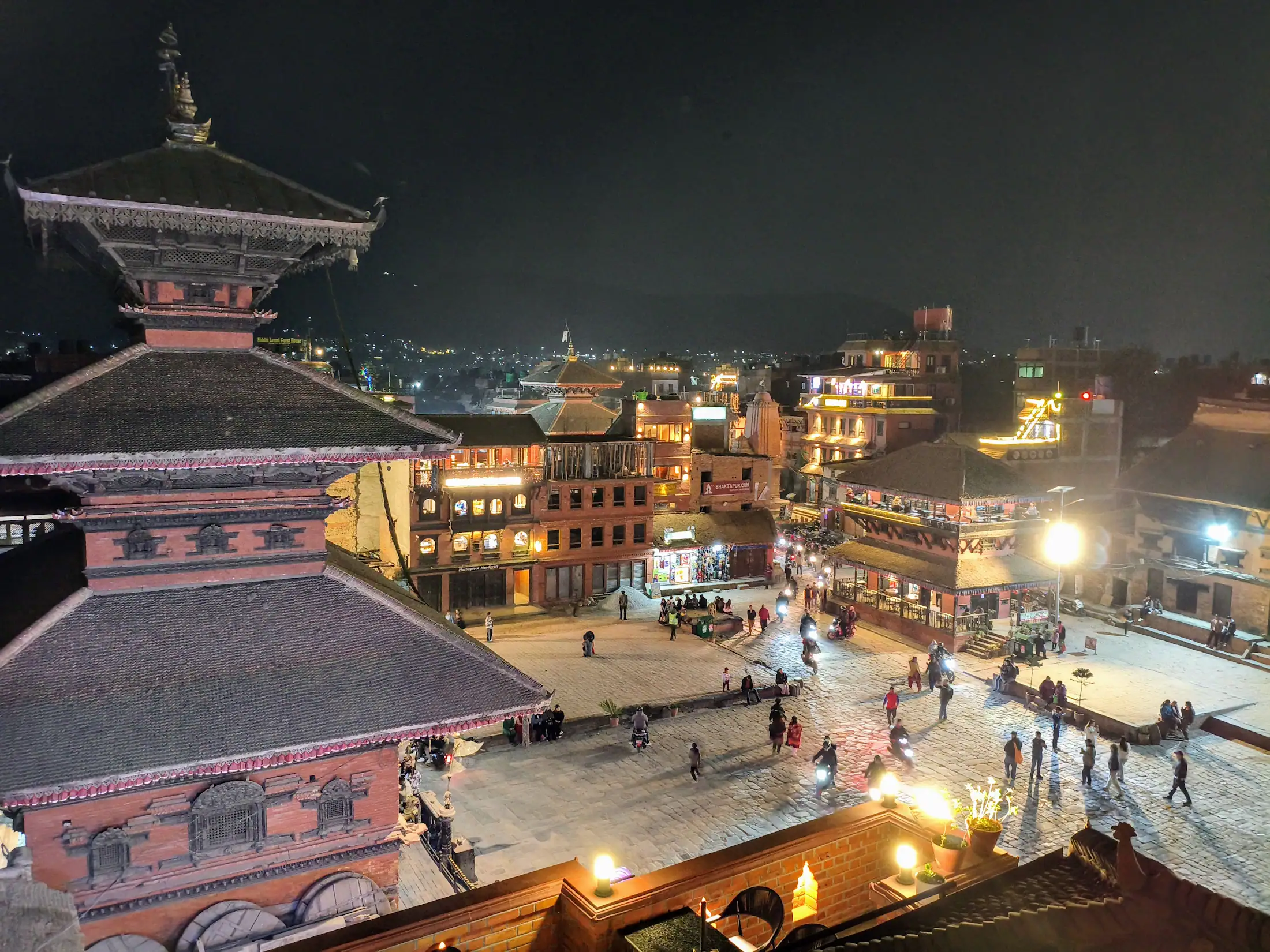
If you only have a few days in the valley, this is a fair question.
If you care about historic architecture, traditional urban life and a slower, more intact old city than central Kathmandu, Bhaktapur is one of the strongest day trips you can make.
If your time is very short and you have not yet seen Kathmandu Durbar Square, Boudhanath, Swayambhunath or Pashupatinath, you may get more value from staying in the city first. Bhaktapur works best for travelers who want depth over variety and who are happy to spend several hours walking through a heritage town rather than ticking off multiple major sites in one day.
Why Bhaktapur stands out
Bhaktapur is one of the three historic royal cities of the Kathmandu Valley, alongside Kathmandu and Patan. What makes it different is the feeling of continuity. The old city is dense with brick lanes, temple squares, carved wooden windows, shrines, courtyards and local activity that still feels lived in rather than staged.
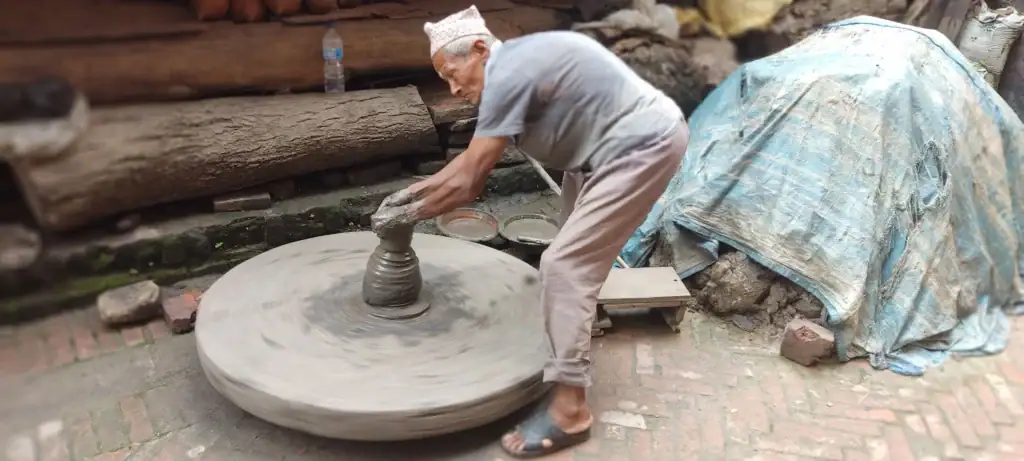
This is not a single monument destination. The appeal is the whole setting. You go for Taumadhi Square, Durbar Square and Dattatreya Square, but also for the space between them. Potters shaping clay, locals gathering on temple platforms, women carrying produce through narrow lanes, children crossing old courtyards on the way home from school. Bhaktapur rewards travelers who like to notice details.
Compared with Kathmandu’s core, it usually feels less chaotic. Compared with Patan, it feels more compactly medieval. That difference matters. If you are looking for an old city where the atmosphere itself is the highlight, Bhaktapur is often the better fit.
Is Bhaktapur worth a day trip from Kathmandu for first time visitors?
Usually, yes, but with one condition: you should know what kind of day you want.
If you want a broad introduction to Nepal’s religious and cultural landscape, staying in Kathmandu may be smarter. A day in the city can combine Hindu and Buddhist sites, cremation ghats, stupas, royal squares and local neighborhoods in a way Bhaktapur cannot. Kathmandu gives you contrast.
Bhaktapur gives you immersion. It is a stronger choice if you want to spend a day in a single heritage city and really absorb it. First time visitors often enjoy that shift. After the traffic, noise and sensory overload of Kathmandu, Bhaktapur can feel easier to read and easier to enjoy at walking pace.
So the question is not whether Bhaktapur is famous enough. It is whether you want one well-shaped cultural day or a faster sampler of the valley’s biggest landmarks.
What you actually see in a day
A good day in Bhaktapur is not rushed. You enter the old city and move gradually through its main squares and side streets.
Bhaktapur Durbar Square is the ceremonial heart, with palace structures, courtyards and richly carved temples. Taumadhi Square has some of the city’s most dramatic silhouettes, including the tall Nyatapola Temple. Dattatreya Square feels quieter and more residential, with excellent woodwork and a more local rhythm.
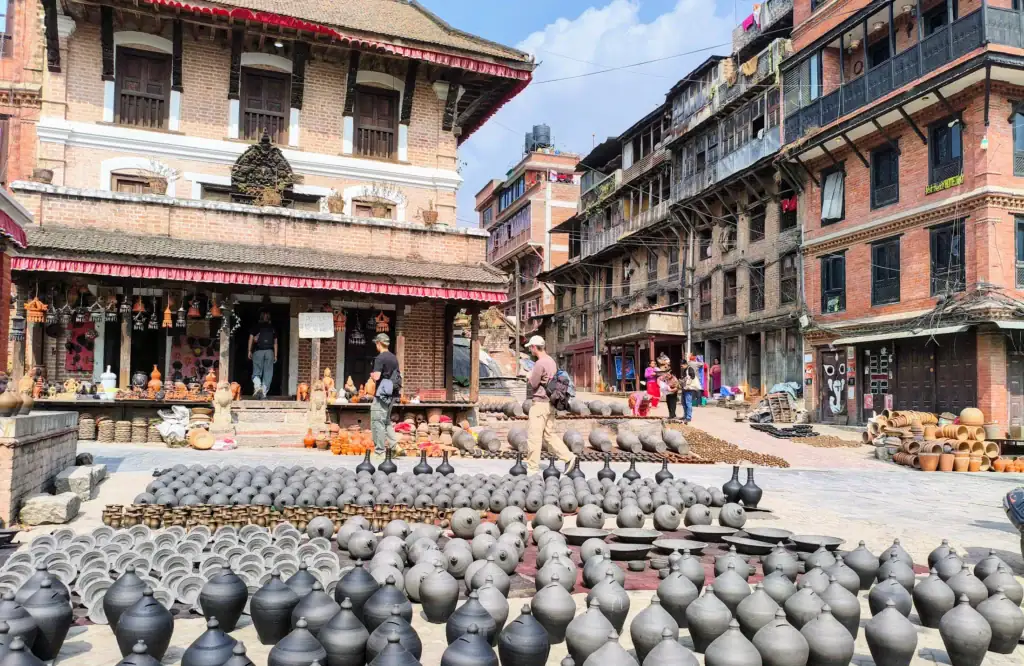
You may also visit Pottery Square, where pottery remains part craft tradition and part everyday business. Depending on your pace, you can add smaller shrines, hidden courtyards and pauses for tea or a proper Newari lunch.
This is why Bhaktapur works well as a day trip. It has enough substance for several hours, but it does not force you into a rushed schedule. You can be purposeful without being hurried.
The trade off: beauty comes with an entry fee
Bhaktapur is not a casual wander in and out destination for international visitors. There is an entrance fee, and it is high enough to factor into your decision.
The Bhaktapur Durbar Square entry fee for foreign nationals is NPR 1,800 per person. SAARC nationals pay NPR 500. Nepali citizens pay NPR 150.
For many international travelers, this is still worth paying because the city offers far more than a single square. But if you are traveling on a tight budget and already paying entry fees at multiple heritage sites in the valley, Bhaktapur may feel expensive for one day.
That is the clearest argument against it. Not that it disappoints, but that the cost can be hard to justify if architecture and historic urban spaces are not a priority for you.
How long do you need?
Bhaktapur deserves more than a quick look. Half a day is possible, but a full day is better if you want the city to unfold properly.
Travel time from Kathmandu depends on traffic, route and time of day, but many visitors should expect around 45 minutes to 1.5 hours each way. On paper, that still makes Bhaktapur an easy day trip. In practice, traffic can shape the experience more than people expect.
If you leave late, arrive tired and try to fit Bhaktapur into an already packed day, it can feel less rewarding. If you leave in the morning and give it breathing room, the city makes much more sense.
For travelers who enjoy photography, architecture or slow walking, a full day is not too much. For travelers who move fast and prefer landmark collecting, three to five hours inside the old city may be enough.
Who will love it and who may not
Bhaktapur is especially worth it for travelers interested in heritage, urban history, traditional craftsmanship and Newari culture. Couples often enjoy it because it feels atmospheric without demanding intense logistics. Solo travelers usually find it manageable and rich in detail. Students, photographers and anyone with an interest in temple architecture often come away very pleased.
It may be less compelling for travelers with young children who are already tired of temples and squares, or for visitors whose main goal is mountain scenery, nightlife or high energy city experiences. Bhaktapur is about texture, history and observation. If that sounds appealing, it delivers.
Mobility can also matter. The old city involves a lot of walking on brick and uneven surfaces. That does not make it inaccessible to everyone, but it is something to consider before committing a full day.
Bhaktapur vs Patan
If you are choosing just one extra heritage city beyond Kathmandu, Patan is Bhaktapur’s main competitor.
Patan is closer for many travelers staying in central Kathmandu and easier to combine with other sites. It has outstanding art, a superb museum and a more flexible half day format. If you want something elegant and efficient, Patan is often the practical choice.
Bhaktapur feels more immersive. It asks for more time and a bit more transport effort, but it gives you a stronger sense of stepping into a preserved historic urban world. If you only want one focused cultural day trip, Bhaktapur often leaves the deeper impression.
Should you go independently or with a guide?
You can visit Bhaktapur independently. The site is walkable, the main squares are easy enough to navigate and many travelers enjoy the freedom of setting their own pace.
But Bhaktapur becomes more meaningful with context. Without guidance, many visitors see beautiful buildings and take photos, but miss the religious significance, the royal history, the Newari identity of the city and the details hidden in plain sight. A good guide helps you read what you are seeing rather than just passing through it.
That matters even more if this is your first trip to Nepal and you want to understand the valley, not just admire it.
Our honest take
Yes, Bhaktapur is worth a day trip from Kathmandu if you want one of the valley’s most rewarding heritage experiences and you are comfortable paying NPR 1,800 for entry. It is especially worth it if you prefer depth, atmosphere and historic character over a faster checklist of major sites.
If your schedule is very tight, your budget is stretched or you have not yet seen Kathmandu’s core monuments, you may want to stay in the city first. But if you have one free day and want a place that feels distinct, coherent and culturally rich, Bhaktapur is an easy recommendation.
Give it time, walk slowly and look beyond the obvious landmarks. That is usually when Bhaktapur stops being a day trip and starts becoming one of the places people remember most from the valley.
Give it time, walk slowly and look beyond the obvious landmarks. That is usually when Bhaktapur stops being a day trip and starts becoming one of the places people remember most from the valley.