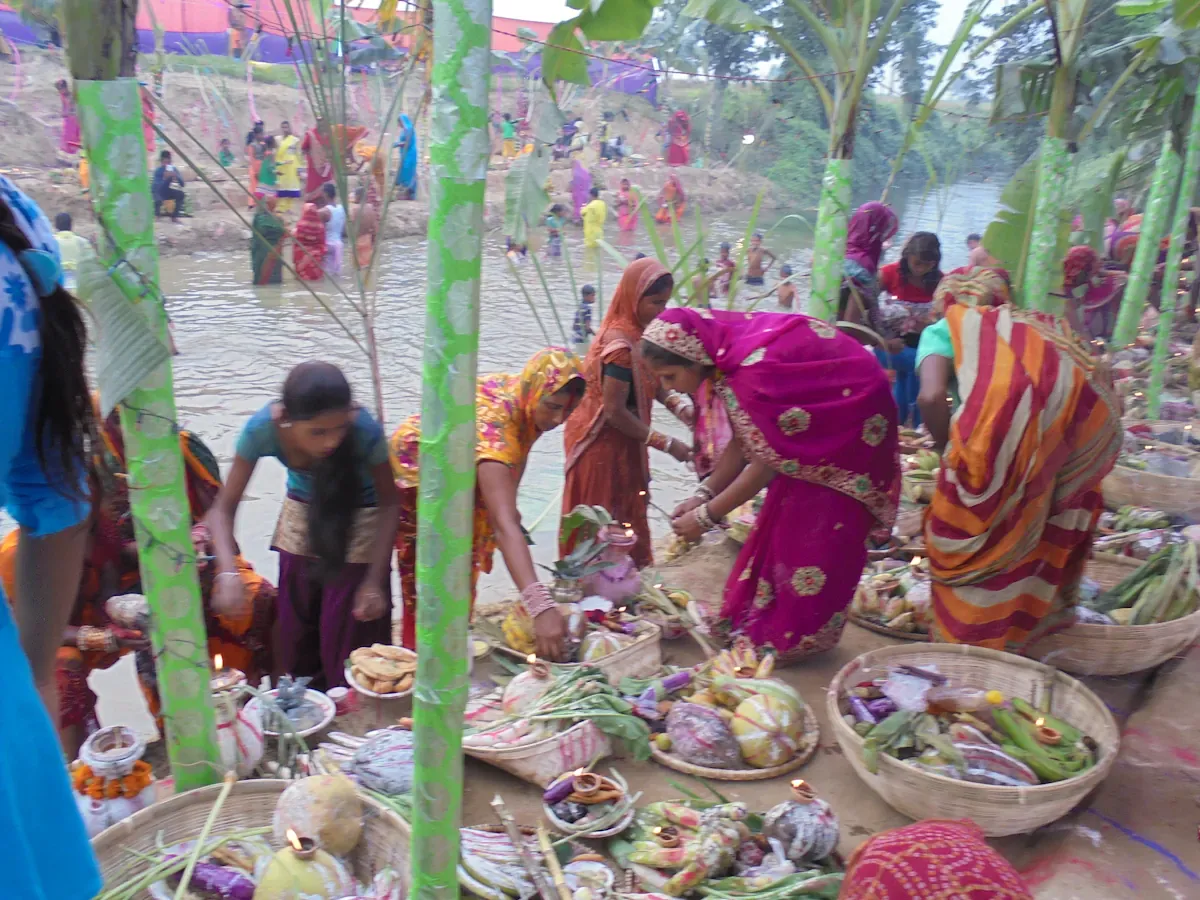
Shortly before sunset, women stand in the water at Gaurighat on the Bagmati River with bamboo trays piled high with fruit, sugarcane and homemade biscuits. As the sun goes down they lift the trays and pour water towards it, while their families crowd the riverbank behind them. This is Sandhya Arghya, the evening offering to the setting sun and the main day of Chhath, the sun festival of Nepal’s southern plains.
Chhath falls in late October or November and its main day is a public holiday across Nepal. The box below always shows the next date.
When is Chhath?
Chhath means “sixth”. The main day falls on the sixth day of the bright half of the lunar month of Kartik, about a week after Laxmi Puja, the night of lights during Tihar. That puts it in late October or November. The evening offering (Sandhya Arghya) is followed the next morning by the dawn offering (Usha Arghya).
For the other festivals of the year, see our Nepal festival calendar.
What Chhath is about
Chhath is a Hindu festival for the sun god Surya and Chhathi Maiya, a mother goddess linked to him. Devotees thank the sun for sustaining life and ask for the health and wellbeing of their families. Its roots lie in Mithila, the old cultural region that today spans Nepal’s Madhesh Province and the Indian state of Bihar. It is the biggest festival of the Tarai, Nepal’s southern plains.
What sets Chhath apart is how direct it is. There are no priests, no mantras and no temple: the devotee, the family, the water and the sun are enough. Most devotees are women, but anyone can take on the fast. Communities clean the riverbanks and ponds beforehand and build temporary ghats, the steps or platforms where people enter the water, from mud, banana leaves and bamboo.
The four days of Chhath
Nahay Khay, two days before the main day, opens the festival with a ritual bath and a single vegetarian meal, traditionally rice with bottle gourd.
Kharna, the day before the main day, is a day of fasting, broken after sunset with roti and kheer (sweet rice pudding). Then the hard part starts: a fast of about 36 hours without food or water.
Sandhya Arghya is the main day, described below.
Usha Arghya, the next morning, brings everyone back to the water before dawn to make offerings to the rising sun. After that the devotees break their fast and the offerings are shared out as prasad, blessed food.
Sandhya Arghya: the evening offering
In the afternoon, families carry the offerings to the ghat in flat bamboo trays and baskets. A tray holds fruit, coconut, sugarcane and thekua, a crunchy biscuit of wheat flour and jaggery that is made only for Chhath. By then the devotee has gone without food or water since the night before.
As the sun drops, the devotees step into the river or pond and offer arghya, water and milk poured towards the setting sun, holding up the trays. Women sing Chhath songs along the bank, oil lamps are lit and the ghats stay busy well after dark. Many families stay up through the night and return to the water before sunrise for Usha Arghya.
Where to see Chhath in Kathmandu
Chhath came to the hills with families from the Tarai. It has been celebrated in Kathmandu since about 1990 and grew much bigger after a Chhath committee was registered at Guhyeshwori in 2005. Today the main sites are:
- Gaurighat, on the Bagmati between Pashupatinath and Guhyeshwori temple. This is the biggest gathering in the city.
- Kamal Pokhari, the restored historic pond in central Kathmandu, which has become a major Chhath site in recent years.
- Thapathali, on the Bagmati near the bridge to Patan.
Rani Pokhari, the pond opposite Ratna Park, was a Chhath site until the 2015 earthquake damaged it and hasn’t been used for Chhath since. To see Chhath at its full scale you need to go south to the Tarai, to cities such as Janakpur and Birgunj.
Watching Chhath as a visitor
Chhath is a family ritual, not a show, but nobody minds visitors who keep to the bank and give the devotees room. Get there in the late afternoon so you’re in place before sunset; the banks fill up fast and the best spots go to the families with offerings.
The offerings are prepared under strict rules of purity, so don’t touch the trays or step onto the ghat platforms. Wide shots of the crowd and the lamps on the water are the photos that work best here. For a close-up of a woman in the water, ask first. Remember that she hasn’t eaten or drunk for a day and a half.
What’s open and closed
The main day of Chhath is a national public holiday. The government sometimes adds the following day for the dawn offering. Government offices, banks and schools close; shops, restaurants, hotels and tourist sights stay open. Madhesh Province gives additional provincial holidays.
Combining Chhath with a tour
Gaurighat is a short walk from Pashupatinath, so Chhath fits naturally with our Pashupatinath Temple and Aarati Ceremony tour or the Pashupatinath and Boudhanath tour. If you want a guide to take you to the ghats at sunset on your own schedule, book a private tour.
What you'll miss at every site without a local guide
A practical guide to Kathmandu's four UNESCO sites — what actually happens there that most visitors never understand. We'll also occasionally send tips and offers from Amazing Kathmandu Tours. Unsubscribe anytime.
No spam. Useful information. Unsubscribe anytime.
Frequently asked questions
When is Chhath?
Chhath falls in late October or November, about a week after Laxmi Puja during Tihar. The main day, Sandhya Arghya, is the sixth day of the bright half of the lunar month of Kartik. The dawn offering follows the next morning.
What is Sandhya Arghya?
Sandhya Arghya is the evening offering on the third day of Chhath. Devotees who have fasted without food or water stand in a river or pond and offer water and milk to the setting sun, holding trays of fruit and thekua biscuits.
Where can I see Chhath in Kathmandu?
The biggest gathering is at Gaurighat on the Bagmati River near Pashupatinath. Kamal Pokhari in central Kathmandu and Thapathali on the Bagmati are also major Chhath sites.
Can tourists watch Chhath?
Yes. The ghats are public places and visitors can watch from the bank. Keep space for the devotees, don’t touch the offerings and ask before taking close-up photos.
Is Chhath a public holiday in Nepal?
Yes. The main day is a national public holiday. In some years the government also gives the following day off for the dawn offering. Shops, restaurants, hotels and tourist sights stay open.
Sources
- Hamro Patro: Nepali public holidays 2083
- The Kathmandu Post: Government declares public holiday on Monday for Chhath
- The Kathmandu Post: Nepal’s calendar gives Chhath one day, the festival takes five
- Spotlight Nepal: Devotees offer prayers to the setting sun at Gaurighat
- All India Radio News: Sandhya Arghya performed in Nepal
- Kantipur: Chhath ends with offering argha to the rising sun
- Dekho Panchang: Chhath Puja 2028