
Nepal wants to stop exporting only electricity and start exporting computing power. The ruling party has promised to make that switch within five years, the 2026/27 budget announced a national AI computing centre and investors from India, the US and the Gulf have been knocking on doors in Kathmandu. This week a columnist in The Himalayan Times added a warning that nobody in the debate had raised: before data centres come, Kathmandu needs a water meter.
The stakes are high. One in five Nepalis lives below the national poverty line and close to 800,000 labour permits for work abroad are issued every year. If Nepal can turn its rivers into a digital industry, it gets something it has never had: a way to earn more from its own resources without sending its young people away. So how big is the opportunity really, what stands in the way and what can Nepal realistically expect?
Why data centres look at Nepal
The argument starts with water and mountains. Nepal now has 4,120 MW of installed power, almost all of it hydropower. It added 529 MW in the last fiscal year alone. In the monsoon the country produces far more than it uses: generation reaches about 4,100 MW against a domestic peak of about 2,200 MW. Even with exports to India at the approved maximum of about 1,200 MW, up to 900 MW at times could not be used and hydropower plants were told to cut output.
And there is much more to come. The government’s new energy strategy aims for 28,500 MW by 2035, almost seven times today’s capacity, with 15,000 MW meant for export. That would need about US$46.5 billion of investment. India has agreed in principle to buy 10,000 MW within ten years, but every extra megawatt depends on new transmission lines and on India’s approval.
Selling that surplus abroad works, but at a low price. Last fiscal year Nepal exported electricity worth Rs 29.32 billion (about US$200 million), an average of Rs 7.56 (about US$0.05) per unit. A data centre turns the same kilowatt-hour into a service that sells for many times more. Add a cool climate in the hills, which cuts the energy needed for cooling. Add a young IT workforce and the pitch writes itself. The government’s National AI Policy of 2025 explicitly proposes data centres in the cold Himalaya and the Ministry of Communication and IT will present an AI data centre in Rolwaling or Mustang at the Nepal Infrastructure Summit on 9 and 10 December.
Why it matters so much for Nepal
Nepal is one of the poorest countries in Asia. GDP per person was about US$1,536 in 2025, the whole economy about US$45 billion. The last national living standards survey found 20.27% of Nepalis below the poverty line, down from 25.16% in 2011. The World Bank’s latest brief shows the other side of that progress: extreme poverty has almost disappeared at 2.4%, but more than half of Nepalis live on less than US$8.30 a day and one bad harvest, illness or flood can push them back.
An economy that runs on people leaving
What keeps many families above the line is money sent home from abroad. In the fiscal year that ended in July, Nepalis working overseas sent home Rs 2,363 billion (US$16.2 billion), 37% more than the year before and more than a third of the entire economy. That is about 80 times what the country earned from selling electricity. In the same year the government issued about 406,000 labour permits to first-time migrants and another 386,000 to workers going back to jobs in the Gulf, Malaysia and elsewhere.
The money pays for school fees, houses and food, but the price is paid at home. About one in five young Nepalis between 15 and 24 who look for work can’t find any, and the International Labour Organization has named Nepal as a country where frustration over poor job prospects spills into political unrest. That frustration brought down the government in September 2025, when the Gen Z protests left more than 70 people dead. In villages across the hills you meet grandparents raising children whose parents work in Qatar or Malaysia.
IT is already the exception
One sector shows that Nepal can earn abroad without people leaving. In 2022 IT exports were worth about US$515 million and employed more than 70,000 people. The industry estimates they passed US$1 billion in 2025, with about 100,000 people working in software, outsourcing and digital services, most of them in Kathmandu. In 2024 the government set a target of Rs 3 trillion of IT exports in ten years (about US$20 billion at today’s rate) and 1.5 million direct and indirect jobs.
This is where data centres matter most. Cloud capacity at home would make Nepali digital services faster and cheaper to run, keep Nepali data in Nepal and train the engineers a bigger industry needs. Electricity exports earn money for the state; a digital industry earns it for tens of thousands of families.
How much is being invested?
Less than the headlines suggest. All operating and planned data centres in Nepal together add up to about 15–20 MW. The main projects:
| Project | Location | Capacity | Investment | Status |
|---|---|---|---|---|
| WorldLink / Data World | Matatirtha, Chandragiri | 3.5 MW, 520 racks | Not disclosed | Operating |
| BLC Holdings and Yotta (India) | Ramkot, Kathmandu | 4 MW | Rs 3.5 billion (about US$25 million) | Announced in 2024 |
| Bichuten Data Vault | Chobhar and Birgunj | 240 kW, rising to 5 MW by 2030 | Rs 2.5 billion (about US$18 million) | Under construction |
| Ncell | Nakkhu, Lalitpur | 250 racks | Rs 2 billion (about US$14 million) | Operating since 2021 |
| Nepal Electricity Authority | Syuchatar | 1 MW | Financed by the Asian Development Bank | Operating |
| Sovereign AI Compute Center | Syuchatar | “Thousands” of graphics processors | Not published | In the 2026/27 budget |
For comparison: an AI data centre costs US$30–50 million per MW. A single 100 MW campus would cost US$3–5 billion, against a national economy of about US$45 billion. The big money is still talk. Polygon co-founder Sandeep Nailwal promised “hundreds of millions of dollars” after meeting the finance minister and the central bank governor in November, but no amount, capacity or agreement has been made public. A Nepali business delegation pitched “Hydro-to-Data” in Washington in April and came back without funding commitments. And a reported Rs 5 billion investment by Meta in WorldLink turned out to be not true at all.
The challenges
Power is cheap in summer and short in winter
Data centres need the same amount of power every hour of the year. Nepal’s run-of-river hydropower doesn’t deliver that. From mid-January to mid-March the electricity authority needs 450–500 MW extra around the clock and 800–900 MW at peak times. This winter India has approved imports of up to 350 MW. A data centre running on monsoon surplus would compete with households for scarce power in winter. Bhutan, which already hosts large bitcoin mines on hydropower, runs into the same problem: its output falls by about 80% in winter.
The August flood on the Bhotekoshi showed another weak spot. It damaged hydropower plants along the river and three months later 431 MW is still disconnected from the grid. The World Bank cut its growth forecast for this fiscal year to 3.7% partly because of the flood. Investors will want to know where their power comes from when a river takes out a plant.

Water
This is the point of the Himalayan Times column. The Kathmandu Valley needs about 472 million litres of water a day and produces only about a quarter of it locally; in many neighbourhoods piped water arrives once every three to seven days. A medium-sized data centre that cools with water can use about 1.14 million litres a day. The author proposes monthly public reporting of water use per site and water prices that reflect scarcity, cheaper for recycled water, rainwater or air cooling. It’s a sensible condition: there are no water figures for any data centre in Nepal yet and data centres don’t even need a full environmental impact assessment.
Earthquakes
Nepal lies on one of the most active fault zones in the world. The 2015 Gorkha earthquake (magnitude 7.8) killed almost 9,000 people. The Kathmandu Valley sits on soft lake sediments up to 600 m deep that amplify the shaking. The national building code, NBC 105:2020, puts Kathmandu in a high seismic zone on the weakest soil class, but doesn’t mention data centres at all.
Building them earthquake-proof is possible, but it costs money. The proven methods are:
- Build on rock outside the valley’s soft sediments, away from fault lines and flood-prone river banks.
- Put the building on base isolators: it rests on rubber-and-steel bearings that absorb the ground movement, so the servers inside barely move.
- Brace and anchor everything inside: server racks, batteries and cooling units are braced so they don’t fall over or break loose.
- Design for the code’s highest building class, with the importance factor of 1.5 used for power stations and hospitals, not the 1.25 for telephone exchanges.
- Keep a second site. No building survives everything, so critical data needs a mirror in another region or abroad.
Ncell says its container data centre can withstand a magnitude 9 earthquake; nobody has independently verified that. And the government’s own backup centre in Hetauda sits in an even higher seismic zone than Kathmandu.
Geopolitics
A data centre is only as good as its connection to the world. Nepal reaches the undersea internet cables only through India. Most of its international bandwidth comes from Indian providers; the fibre link with China, open since 2018, carries a nominal share. When one Indian supplier cut capacity over a payment dispute in 2023, a government committee recommended that no supplier should provide more than 60%.
Power is just as political. Since 2022 India refuses to buy electricity from projects with investment from countries it has no power agreement with, in practice China. Any data centre with Chinese equipment, money or partners risks running into the same wall, while a Western or Indian cloud provider brings questions about data sovereignty and foreign access to data. Nepal still has no comprehensive data protection law, only the Privacy Act of 2018 and a draft policy from 2025. Prime Minister Balendra Shah’s state visit to India this week brought an aid and energy package of about US$1.6 billion, including the Lower Arun hydropower project and new cross-border transmission lines, but no agreement on data, fibre or data centres.
Does the new government help?
Yes, more than any government in years. After the Gen Z protests of September 2025 the Rastriya Swatantra Party won 182 of the 275 seats in the March 2026 election, two short of a two-thirds majority. Balendra Shah, a structural engineer and former mayor of Kathmandu, has been prime minister since 27 March. For the first time in decades, a government doesn’t depend on coalition partners that can bring it down at any moment. The party has also made “from electricity exports to compute exports” part of its programme and the budget includes an AI processing centre at Syuchatar.
Stability alone isn’t enough. Nepal is still on the Financial Action Task Force’s grey list for money-laundering risks, its credit rating is BB-, there is no special electricity tariff for data centres and the Investment Board has not approved a single data centre project. Nepal also has no rules yet for how data centres are licensed, taxed or supplied with power. Investors will look for those decisions, not for speeches.
What could data centres bring?
More money from the same electricity
The economic case is simple arithmetic. Nepal sells a unit of electricity to India for about US$0.05. An AI server with eight graphics processors uses up to 10.2 kW and rents out for about US$2 per processor per hour at the cheapest cloud providers. Per kilowatt-hour that is about US$1.50 in rental income, around 30 times what the same electricity earns at the border.
That is turnover, not profit, and most of it goes to whoever paid for the servers. At US$30–50 million per MW the equipment is far more expensive than the power. What Nepal keeps depends on who owns the data centre, what it pays for electricity and land and how much tax it pays.
How many jobs?
Fewer than most people hope. Data centres are built to run with almost nobody inside. A study of completed projects in the UK counted 8.6 direct jobs per MW and as few as 1.6 per MW for large planned campuses. Highly automated campuses in the US run with 25–40 permanent staff per 100 MW. In Norway the whole data-centre industry employed 677 people in 2024.
For Nepal that means a 100 MW campus would create somewhere between a few dozen and a few hundred permanent jobs, plus a few years of construction work. Against close to 800,000 labour permits a year, data centres alone will not stop migration. The jobs that count come around them: software companies, cloud services, AI start-ups and the engineers who maintain the grid. That is what the IT export target depends on.
What Bhutan shows
Nepal’s eastern neighbour went first. Bhutan’s state investment company mined bitcoin with hydropower and built up holdings worth about US$1.1 billion by late 2024, more than a third of the country’s GDP. In 2023 it sold about US$100 million of crypto, which helped pay for a pay rise for civil servants.
The bigger mines tell a different story. The Singapore-based company Bitdeer runs 600 MW of mining in Bhutan. Its two sites employ about 60 Bhutanese and Bhutan holds no stake in them; the country earns tax, land lease and electricity sales. The largest site, at Jigmeling, pays for power imported from India. The lesson for Nepal: cheap power attracts investors easily, but the country only gets rich from it if it negotiates ownership, jobs and prices before the contracts are signed.
What can Nepal expect?
Our assessment: Nepal will not become a Himalayan Iceland in the next five years. What is realistic is growth from about 20 MW today to tens of megawatts by 2030, driven by local demand from banks, telecom companies, the government and Nepali software firms. That keeps Nepali data in Nepal and builds the skills a bigger industry will need.
The big AI campuses of 100 MW and more will only come once four things are in place: year-round power through storage dams or guaranteed winter imports, a second international fibre route that doesn’t depend on one neighbour, a data protection law and a clear rule on water use.
When those investors come, the deal matters more than the megawatts. A Nepali share in ownership, a power price well above the export price, training and jobs for Nepali engineers and public reporting on water would make sure the value stays in the country. Without those conditions Nepal risks repeating its old pattern: exporting a raw resource cheaply while the value is made elsewhere. With them, its rivers could pay for something it has needed for decades: work at home for the young people who now leave. The surplus electricity is already there. The question is whether Nepal can build the rest before the next monsoon’s spill is wasted again.
What you'll miss at every site without a local guide
A practical guide to Kathmandu's four UNESCO sites — what actually happens there that most visitors never understand.
Plus Nepal Explained: culture, festivals and must-know facts, once a month. Unsubscribe anytime.
FAQ
Does Nepal have data centres?
Yes, but small ones. WorldLink, Ncell and the Nepal Electricity Authority run data centres in and around Kathmandu and more are being built. All operating and planned projects together add up to about 15–20 MW.
Why is Nepal interesting for data centres?
Nepal produces more hydropower than it can use in the monsoon and sells the surplus to India for about US$0.05 per unit. The cool climate in the hills reduces the energy needed for cooling and the IT sector has about 100,000 workers.
How many jobs can data centres create in Nepal?
Directly, not many. Studies abroad count between 25 and 860 permanent jobs for 100 MW of capacity. The larger effect comes from the software and cloud companies that grow around local data centres.
Can a data centre in Nepal survive an earthquake?
Yes, if it is built for it: on rock outside the Kathmandu Valley’s soft sediments, on base isolators, with braced server racks and a second site elsewhere. Nepal’s building code has no specific rules for data centres yet.
How much does Nepal earn from electricity exports?
Rs 29.32 billion (about US$200 million) in the fiscal year 2025/26, at an average of Rs 7.56 per unit. Remittances from Nepalis working abroad brought in about 80 times as much.
What is the Sovereign AI Compute Center?
A national AI computing centre at Syuchatar in the Kathmandu Valley, announced in the 2026/27 budget. The government has not published its cost or capacity.
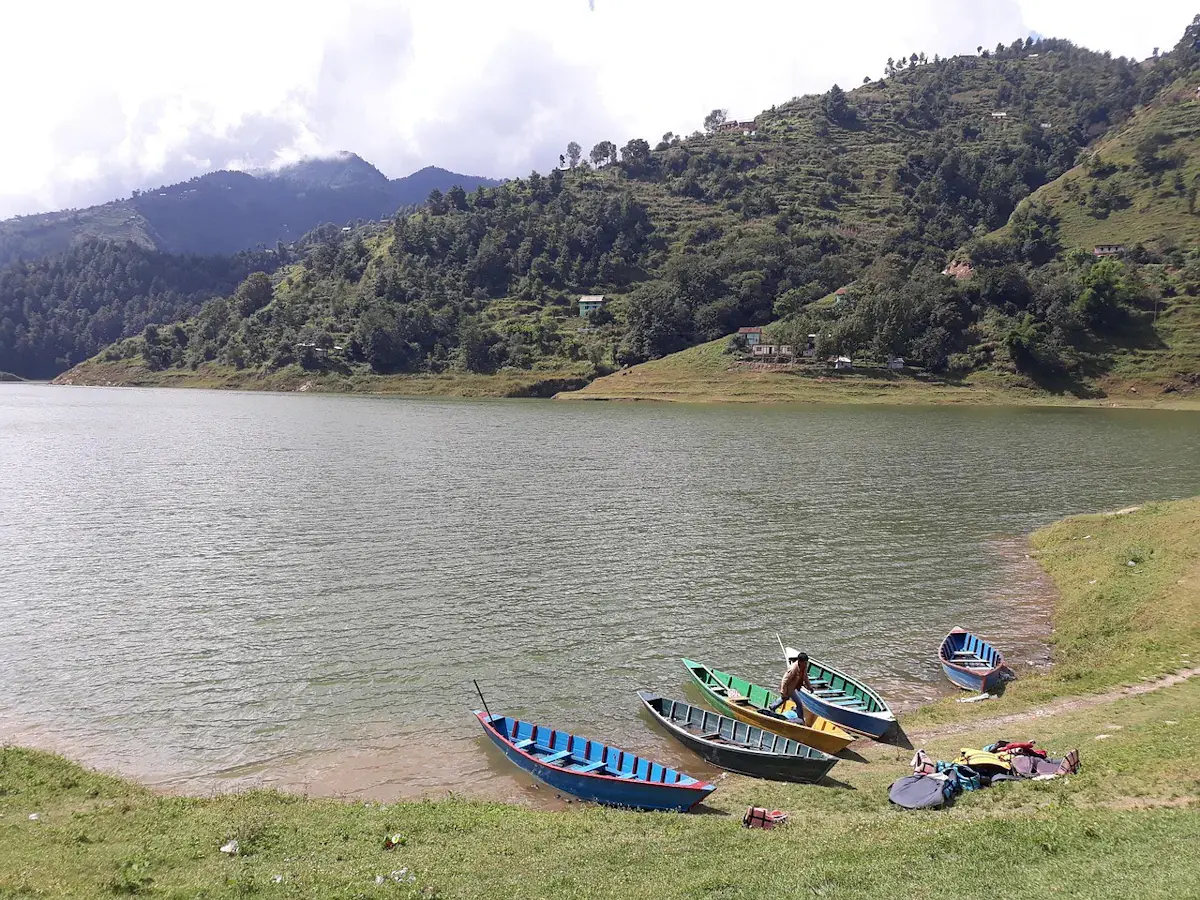
Main photo: Kulekhani reservoir (Indrasarovar), by pawankawan / Pixabay