



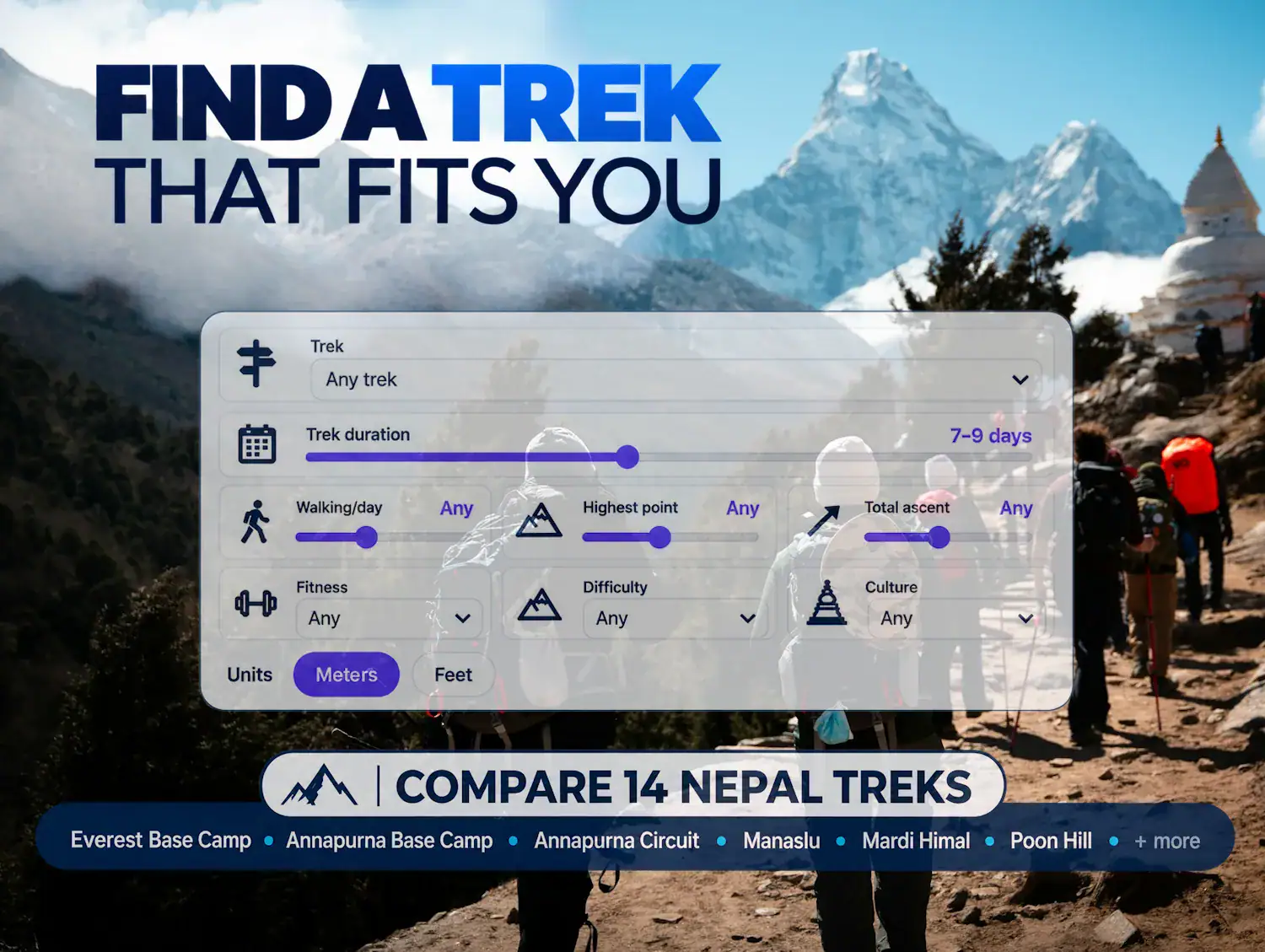
Trekking in Nepal is a serious adventure, and choosing the right trek deserves serious preparation. Consider this guide part of that preparation.
Not sure where to start? Try our Nepal Trek Finder below. Choose how many days you want to trek, then filter by fitness, experience, walking hours, altitude, climbing and cultural interest. It compares 14 of Nepal’s best-known treks and shows which ones actually fit you.
Or keep reading. This guide brings together practical information, the experience of our guides and the questions and experiences shared by hundreds of travellers who have trekked in Nepal. We compare Everest Base Camp, Gokyo, Annapurna Base Camp, the Annapurna Circuit, Mardi Himal, Poon Hill, Manaslu, Upper Mustang and the main Langtang-region treks.
Most of all, enjoy the preparation. It is part of the adventure.
Please note: Bring money to Nepal, not just your backpack
Nepal can be an inexpensive country to travel in, and there is nothing wrong with travelling on a budget. But when comparing trekking prices, it is worth looking at where the savings come from.
Our price indications include a porter.
Porters carry weight at altitude, earn their living from trekking and are part of Nepal’s tourism economy. Use a porter not only to make your trek easier and more enjoyable, but also for the social impact: your trek creates work and income for someone in Nepal.
Come to Nepal. Trek. Spend money. Let local people earn from your visit.
If you’re planning to fly halfway around the world just to walk for as little money as humanly possible, don’t take that flight. Take a bus to the edge of your own city and walk into the woods.
Ultimate Nepal Trek Finder
How to read the numbers & tipping guidance Show
Trek duration is the usual trekking time, not your complete Nepal holiday.
Walking per day is a typical daily range. Individual days can be shorter or considerably longer.
Highest point is the maximum elevation normally reached on the trek.
Highest sleeping altitude is useful because sleeping high can affect acclimatisation differently from briefly reaching a high viewpoint or pass.
Total ascent is the approximate cumulative climbing over the trek. It is not simply the difference between the starting point and highest point.
Average ascent per walking day gives an indication of how much climbing is spread across the itinerary. Actual days vary considerably.
Fitness describes the minimum general fitness level we would normally recommend. Selecting Good also shows treks suitable for Standard fitness. Selecting Excellent shows all fitness levels.
Experience is a practical guide to the amount of previous trekking experience we would normally recommend.
Difficulty is only a broad description. Always look at duration, walking hours, altitude and climbing as well.
Culture describes the overall cultural element of the trek. The individual card also separates villages, monasteries and religion, and architecture and heritage.
Crowd expectation estimates how busy the trek normally feels during the main trekking seasons, particularly October–November and March–April. It considers trail traffic, bottlenecks and pressure on teahouses rather than simply counting annual visitors. A Low rating does not mean you will have the trail to yourself, and festivals or pilgrimage dates can make normally quiet routes temporarily very busy.
Restricted-area requirements only appear when relevant. Restricted regions require an additional permit and must be arranged through a registered Nepal trekking agency.
Permit prices are shown in approximate US dollars. Nepalese rupee permit prices are converted using the Nepal Rastra Bank exchange rate, so the displayed dollar amount can change.
Price indication separates the trekking itinerary from a longer complete Nepal package whenever the published package duration is longer than the trek itself. Trek-only reference means Day 1 is already part of the trekking itinerary; it may include transport to the trailhead, but it does not add separate Kathmandu arrival or final departure days. Complete Nepal package can include arrival, departure, Kathmandu/Pokhara travel, flights, transfers or other days around the trek. The two references can come from different established Nepal operators, so compare the inclusions as well as the headline price. Prices are included for comparison only and are not booking prices from Amazing Kathmandu Tours. All permit costs shown in the Trek Finder are included in the price indication; they are displayed separately so you can see their value, not because they are an additional charge. Other inclusions such as porter, meals, flights and transfers vary by source and are noted where relevant. Tips are not included.
Tipping guidance
Tips are not included in the prices shown in the Trek Finder. Tipping is customary in Nepal's trekking industry, but the amount is ultimately your decision and can reflect the service you received.
As a practical guideline:
| Suggested tip | Amount |
|---|---|
| Trekking guide | $10–15 per trekking day per group |
| Porter | $7–10 per trekking day per porter |
| Driver – short transfer | $3–5 per group |
| Driver – full day / long-distance drive | $5–10 per group |
These amounts are per guide, porter or driver — not per traveller. So if two people are trekking together, you don't each need to tip the guide $10–15 per day.
How to Choose a Trekking Company
Yes, choose a trekking company. Use a trekking company. Safety first. Always book with a registered and licensed trekking agency and experienced, licensed guides. Trekking in Nepal can take you into remote mountain areas, far from hospitals, roads and other immediate assistance. If something goes wrong, getting help quickly matters.
An experienced trekking company has more than just a guide on the trail. It has an operational network behind that guide: people who can arrange transport, contact local authorities and medical services, coordinate an evacuation and respond quickly when plans suddenly have to change.
Verify the company: This should not be an optional check. Before you book or pay, actually look up the trekking agency in the Trekking Agencies’ Association of Nepal (TAAN) Members Directory.
This is not just paperwork. If the company taking you on a restricted-area trek is not properly registered, it cannot obtain the required restricted-area permit for you. No permit, no trek. And if something goes wrong in the mountains, you want to be travelling with a properly registered company that can identify you, account for your itinerary and coordinate with the authorities and rescue services.
Be the responsible adult for two minutes, even if that is normally not your thing. You are about to walk for days into remote mountains, well outside your comfort zone. Checking who you are trusting with your safety is worth the effort.
Direct link to our trekking partner’s registration on the TAAN website
Check the guides: Ask whether your guide is licensed, experienced on the route and trained to recognize altitude sickness and other trekking emergencies. Also ask about their English. Guide prices vary, and generally you pay more for a guide with stronger English and communication skills.
Ask about emergency procedures: A professional operator should be able to explain what happens if you become ill or injured, cannot continue, need to change the route or require an emergency evacuation.
Before you choose your trek: what does trekking in Nepal actually look like?
If this is your first trek in Nepal, there are a few basics worth understanding before comparing routes. Where will you sleep? Do you carry a tent? What is TIMS? Do you need a guide? Who carries your luggage? These may sound obvious once you have trekked in Nepal, but they certainly are not obvious before your first trek.
Where do you sleep?
On most of the popular treks in this guide, you normally sleep in teahouses. Despite the name, these are not cafés. They are simple mountain lodges with guest rooms, a dining room and meals.
Standards vary enormously. At lower elevations some feel more like small guesthouses, with private rooms, charging, Wi-Fi and sometimes hot showers. Higher in the mountains, expect things to become much more basic. Rooms may be cold, bathrooms may be shared and electricity, charging, hot water and Wi-Fi may cost extra or be limited. A sleeping bag is still sensible on higher treks even when blankets are available.
For the classic teahouse treks covered in this guide, you generally do not carry a tent or camping equipment. Camping is used on some remote routes, specialist expeditions and camping-style itineraries, but it is not how most travellers trek to places such as Everest Base Camp, Annapurna Base Camp or along the Annapurna Circuit.
In busy periods, accommodation can fill up at popular overnight stops. This can matter particularly where the number of lodges is limited.
What do you eat?
On teahouse treks you normally eat at the lodge where you stay. Menus commonly include Nepali dishes such as dal bhat, as well as noodles, soups, rice, potatoes, eggs and other simple trekking meals. Dal bhat usually consists of rice, lentil soup and vegetable curries, often with pickles or other side dishes.
Choice generally becomes more limited as you go higher and farther from the road. You therefore do not normally carry all your food with you on the classic lodge-based treks in this guide.
What is TIMS?
TIMS stands for Trekkers’ Information Management System. It is Nepal’s trekker-registration system.
You will often see TIMS mentioned together with other permits, but they are not the same thing. Depending on the trek, you may also need a national park entrance permit, conservation-area permit, local trekking fee or an additional restricted-area permit.
The Trek Finder shows these separately so that you do not have to decode abbreviations and Nepalese-rupee prices yourself. The normal Nepalese-rupee charges are also shown as approximate US-dollar amounts.
Do you need a guide?
Guide and permit rules in Nepal have changed, while old information remains online. For the routes represented in our Trek Finder, current Nepal Tourism Board rules require a licensed trekking guide.
That does not mean you have to join a group. You can still be the only traveller with your own guide.
Manaslu and Upper Mustang are different again because they include restricted trekking areas. Their additional restricted-area permits have to be arranged through a registered Nepal trekking agency. We explain what that means further down this guide.
For current permit prices and requirements, check our Nepal Entrance Fees & Trekking Permits guide.
Do you carry your own luggage?
You can, but you do not necessarily have to. A guide and a porter do different jobs: the guide leads and manages the trek, while a porter carries luggage.
Some travellers carry everything themselves. Others carry a small daypack and use a porter for their main bag. A backpack that feels perfectly manageable during a two-hour walk at home can feel very different after several consecutive trekking days.
What does a normal trekking day look like?
There is no single Nepal trekking day, but the basic rhythm is often simple. You wake relatively early, have breakfast and start walking. There is normally a lunch stop along the route, and you continue to the next village or lodge, usually arriving during the afternoon. Then you eat, rest and do it again the following morning.
That repetition matters. Being able to walk for six hours once is not the same thing as enjoying six hours of walking for eight consecutive days. At high altitude, walking slowly is not a sign of poor fitness either. A deliberately conservative pace can be exactly what you need.
Important Langtang travel update – September 2026
The Langtang/Rasuwa region is currently dealing with the consequences of the destructive Bhotekoshi flood of 26 August 2026. It is currently not possible to visit Langtang Valley, Gosainkunda, the Helambu Circuit or the Tamang Heritage Trail normally.
Roads, bridges and trails were damaged and access has been severely disrupted. We will not speculate about a reopening date. This is a regional disruption, not a closure of Nepal’s main trekking regions as a whole.
Read our Nepal Flood August 2026 Travel Update for Tourists before making plans for this region.
Quick answer: which Nepal trek should you choose?
Choose Poon Hill if you want a manageable introduction to multi-day Himalayan trekking, lower altitude and strong mountain views.
Choose Mardi Himal if you have limited time and want a mountain-focused route with dramatic ridge views.
Choose Annapurna Base Camp if walking into the Annapurna Sanctuary is the main attraction and you have enough time not to rush it.
Choose the Annapurna Circuit if you want a much larger journey through changing landscapes and cultures and are comfortable with the demands of crossing Thorong La.
Choose Everest Base Camp if reaching Everest Base Camp itself genuinely matters to you.
Choose Gokyo if the Everest region appeals to you but lakes, viewpoints and mountain panoramas matter more than reaching Base Camp.
Choose Manaslu if you want a longer, more remote-feeling circuit and are prepared for high altitude, a major pass and additional restricted-area requirements.
Choose Upper Mustang if old settlements, monasteries, architecture, culture and its unusual Himalayan landscape matter more than a conventional base-camp objective.
Under normal conditions, Langtang also deserves serious consideration if you want a shorter Himalayan trek relatively close to Kathmandu. The current access disruption means it should not presently be planned as a normal trekking option.
Which Nepal trek is best for a first trek?
There is no single beginner trek because “first trek” can mean very different things. A fit person who regularly hikes mountains may be doing their first trek in Nepal but be perfectly comfortable walking six hours a day. Someone else may exercise regularly but have never walked for five consecutive days. Those are different starting points.
For a first multi-day Himalayan trek, we generally prefer routes that give you some margin for mistakes: sensible daily distances, plenty of accommodation, simpler logistics and no obligation to cross an extremely high pass. That usually puts Poon Hill, Mardi Himal and, with enough time, Annapurna Base Camp ahead of the Annapurna Circuit or Manaslu for somebody looking for a cautious first experience.
A first-time trekker does not have to choose the easiest route. They do need an itinerary appropriate to their actual experience. And “easy” should be used carefully in Nepal: a trail may involve no technical climbing and still contain thousands of stone steps, steep ascents, long descents and several consecutive days of walking.
Annapurna Base Camp vs Annapurna Circuit
People often put these together because both contain “Annapurna”, but they are fundamentally different journeys. Annapurna Base Camp (ABC) takes you into the Annapurna Sanctuary, surrounded by high peaks. The Annapurna Circuit travels around the Annapurna massif and crosses Thorong La at approximately 5,416 metres on the classic high route.
ABC is more of a journey into the mountains. The Circuit is a journey through changing regions around them.
Scenery
Choose ABC if your priority is the dramatic sensation of being enclosed by enormous mountains. The final approach into the sanctuary produces the classic ABC experience: instead of looking at a mountain range from a distance, you eventually find yourself surrounded by peaks.
Choose the Annapurna Circuit if variety matters more. Landscapes, vegetation, villages, architecture and climate change as you travel around the massif. The Circuit is not simply Thorong La; the changing journey is the attraction.
Verdict: ABC for concentrated high-mountain drama. Annapurna Circuit for variety and a much bigger journey.
Difficulty
Neither should simply be described as easy. ABC remains lower than Thorong La, but contains considerable climbing and descending. The stone staircases in parts of the Annapurna region can be more tiring than people expect.
The Circuit adds another major issue: altitude. Crossing Thorong La means going above 5,400 metres, making pacing and acclimatisation essential parts of the itinerary. Put simply, ABC involves more repetitive ascent and descent and lots of stairs at a lower maximum altitude, while the Annapurna Circuit is longer, much higher and centred around a serious high-pass crossing.
Altitude
Annapurna Base Camp is approximately 4,130 metres, while Thorong La is approximately 5,416 metres. That difference is substantial. Nobody can reliably predict from fitness alone how well they will acclimatise: a strong runner can get altitude sickness while a slower walker may acclimatise perfectly well. Fitness does not protect you against altitude illness.
Time required
ABC generally fits into a shorter itinerary, while the Annapurna Circuit deserves considerably more time. If you have five trekking days, choose a five-day trek. Do not turn a much longer trek into a five-day transport exercise merely because roads make it physically possible to skip sections.
Crowds
Both are popular. ABC can feel particularly busy during peak periods because trekkers converge into the same valley and use a finite number of teahouses. The Annapurna Circuit is much longer, so travellers can be more spread out. Raw visitor numbers therefore do not tell you exactly how crowded a trek will feel.
Mardi Himal vs Poon Hill vs Annapurna Base Camp
These three make more sense to compare when your Nepal holiday is relatively short. They all use the Annapurna/Pokhara region, but the experience is very different.
Poon Hill
Poon Hill is a good choice for a first multi-day trek, travellers who want to stay at lower altitude, people who value well-established teahouse infrastructure and anyone fitting trekking into a wider Nepal holiday. It is popular for a reason: you get a classic Himalayan viewpoint without entering the altitude range of ABC, Mardi’s higher viewpoints or Thorong La.
The catch? Steps. Lots of them. Lower altitude does not mean flat.
Mardi Himal
Mardi Himal suits travellers with roughly five to seven trekking days who prioritise mountain views and do not have time for a longer route. As you climb above the forest, the trail opens towards Machhapuchhre and the Annapurna range. It is shorter than ABC, but reaches considerably higher than Poon Hill and the upper ridge is more exposed.
Annapurna Base Camp
ABC makes more sense if the sanctuary itself is the reason you are trekking. You need more time and should be comfortable with repeated climbing and descending, but the reward is very different from simply viewing the Annapurna range from a ridge.
For roughly 3–5 trekking days, Poon Hill normally makes the most sense of these three. For around 5–7 days, Mardi becomes very attractive. Once you have roughly 7–11 days, ABC becomes increasingly realistic. Those numbers are not guarantees: exact itineraries depend on starting point, road conditions, weather, fitness and appropriate pacing.
Everest Base Camp vs Gokyo
The first question is not which is better. It is: why are you going to the Everest region?
Everest Base Camp
Choose EBC if reaching Everest Base Camp itself matters to you. That may sound obvious, but it prevents a common mistake: choosing EBC simply because it is the Nepal trek everyone recognises.
Everest Base Camp is culturally and historically significant in mountaineering, but much of the beauty of the trek comes from the journey: Sherpa settlements, monasteries, suspension bridges, the Khumbu landscape, Ama Dablam, increasingly high altitude and viewpoints such as Kala Patthar.
It is also popular. That is part of the experience. If solitude is your main objective, the classic EBC corridor during peak season is probably not your ideal route.
Gokyo
Gokyo gives you a different Everest-region experience. The turquoise Gokyo Lakes, Ngozumpa Glacier and panorama from Gokyo Ri are the main attractions.
Choose EBC if the destination itself matters. Choose Gokyo if lakes and panoramas matter more. Combining EBC and Gokyo can be excellent, but adding high passes such as Cho La changes the physical and logistical demands considerably.
Langtang vs Annapurna
Under normal conditions, this is one of Nepal’s more interesting comparisons. Langtang’s major advantage is geography: it allows travellers based in Kathmandu to reach a substantial Himalayan trekking region without first travelling to Pokhara or flying to Lukla. It combines mountain scenery with Tamang settlements and Buddhist cultural influences.
The Annapurna region offers much more variety in the number and style of routes, ranging from short Poon Hill itineraries to ABC and the Annapurna Circuit.
Historically, many travellers describe Langtang as less commercial than parts of the Annapurna region. But “commercial” can mean several different things: more trekkers, more teahouses, more cafés and menu choices, more vehicle access, more shops, or simply seeing more foreigners. Those are not the same thing.
Almost every established teahouse trek in Nepal is connected to tourism. The better question is: how much tourism infrastructure do you want? More infrastructure can mean more accommodation, better food choice and simpler logistics. Some travellers want that. Others would rather trade convenience for a quieter trail.
Current Langtang situation
For immediate travel, this comparison is currently mainly useful for future planning. Following the 26 August 2026 Bhotekoshi flood, road, bridge and trail access in the Langtang/Rasuwa region was severely affected.
It is currently not possible to visit Langtang Valley, Gosainkunda, Helambu or the Tamang Heritage Trail normally. We will not guess when access will return to normal. Check our Nepal flood travel update before making plans.
When does Manaslu make sense?
Manaslu is sometimes described as a quieter alternative to the Annapurna Circuit. That description is useful but incomplete. It is a substantial high-altitude circuit with remote sections, Tibetan Buddhist cultural influences, a major pass and restricted-area regulations.
Consider Manaslu if you have enough time for a proper circuit, already know you enjoy multi-day trekking, want a more remote atmosphere, value village culture alongside mountain scenery and are prepared for high altitude. It can be somebody’s first Nepal trek, but that does not make it the trek we would automatically recommend to every first-time Himalayan walker. Less crowded does not mean easier.
Why does Manaslu have extra permit requirements?
Parts of the Manaslu route fall inside an official restricted trekking area. This means you need an additional restricted-area permit on top of the normal trekking and conservation-area requirements. The trek must also be arranged through a registered Nepal trekking agency because the restricted-area permit is processed through the agency.
The Manaslu restricted-area permit is US$100 per person for the first seven days from September to November, plus US$15 per additional day. From December to August it is US$75 for the first seven days, plus US$10 per additional day. Other permits are required for the complete trek, as shown in the Trek Finder.
What makes Upper Mustang different?
Upper Mustang should not be selected simply because you want another famous trek. It is different. The attraction includes stark high-altitude desert landscapes, old settlements, caves, monasteries, traditional architecture and Tibetan-influenced culture. The journey is as much cultural as mountainous.
Upper Mustang also falls inside Nepal’s restricted-area system. Its restricted-area permit is therefore additional to normal trekking registration and conservation-area requirements, and the trek must be arranged through a registered Nepal trekking agency because the restricted permit is processed through the agency.
The Upper Mustang restricted-area permit is US$50 per person per day.
Do not assume that because something was allowed on a previous Nepal trip, or because somebody online did it several years ago, the same rules apply today.
How many days should you allow?
Count real trekking days, not the total length of your Nepal holiday. If you land in Kathmandu on Monday and fly home the following Sunday, you do not have seven trekking days. Transfers, preparation, domestic flights, weather margins and returning before your international flight all consume time.
Around 3–5 trekking days
Look first at routes such as Poon Hill. If trekking is only one part of your trip, shorter hiking around Kathmandu Valley can also make more sense than spending a large part of the holiday travelling to and from a trekking region. Do not turn a famous 12-day trek into a four-day trek simply because you recognise the name.
Around 5–8 trekking days
Mardi Himal becomes a strong candidate, while Poon Hill can be done at a more relaxed pace. Some ABC itineraries become possible towards the upper end of this range. Under normal access conditions, routes in the Langtang area would also become relevant.
Around 8–11 trekking days
ABC fits more naturally and longer Annapurna combinations become possible. Under normal conditions, Langtang Valley would also be a logical candidate. This is still not a good reason to rush a classic high-altitude trek such as Everest Base Camp.
Around 12–18 trekking days
Nepal’s larger journeys become more realistic: Everest Base Camp, Gokyo, EBC and Gokyo combinations, Manaslu Circuit, longer Annapurna itineraries and, towards the longer end, the Annapurna Circuit.
More time also gives you something people often undervalue: the ability to stop. An acclimatisation day, poor-weather day or unexpected logistical delay does not immediately destroy the rest of your holiday.
How much does altitude matter?
A lot. Poon Hill reaches roughly 3,210 metres, Annapurna Base Camp about 4,130 metres, Thorong La approximately 5,416 metres, and Kala Patthar on the Everest Base Camp route roughly 5,545 metres. These are significant differences.
Your cardiovascular fitness cannot guarantee how your body will respond to high altitude. This is why the Trek Finder separately shows highest point, highest sleeping altitude, total cumulative ascent and average ascent per walking day. A trek should not be judged using one altitude number alone.
What happens when the weather changes?
Weather does not affect every route in the same way. On Poon Hill, the short duration and relatively close road access usually make itinerary changes easier. On Mardi Himal, cloud and poor visibility can remove much of the reason for climbing the exposed upper ridge. At Annapurna Base Camp, bad weather can slow progress and affect trail conditions in the sanctuary.
On the Annapurna Circuit, snow, ice or strong wind can delay or prevent the Thorong La crossing. For Everest Base Camp and Gokyo, Lukla flight delays and cancellations add another weather-related planning risk before and after the trek. On Manaslu, poor conditions around Larkya La matter more because of the remoteness and limited route flexibility. Upper Mustang’s rain-shadow geography can make it relatively attractive during Nepal’s monsoon, although wind, snow and road conditions can still disrupt travel.
Weather is one reason not to plan a high-altitude trek right up against your international departure.
What kind of trekker are you?
First-time trekker
You do not automatically need the easiest route. You do need to understand whether you enjoy waking up and hiking again for several consecutive days. Poon Hill is a sensible introduction, while regular hikers wanting something stronger may prefer Mardi Himal or Annapurna Base Camp.
Experienced hiker
If long walking days are familiar, your decision shifts more towards altitude, cumulative ascent, remoteness, scenery, weather, culture and available time. That can make the Annapurna Circuit, Gokyo, EBC or Manaslu more interesting.
But low-altitude hiking experience is not high-altitude experience. Being able to walk 30 kilometres in the Alps does not prove how you will acclimatise at 5,000 metres.
Older but fit traveller
Your birth year does not select your trek. Recovery, joints, balance, walking experience and preferred pace are more useful measures. A slower itinerary can completely change the experience, so do not copy somebody else’s aggressive itinerary merely because you think you could probably complete it.
More interested in culture than a base camp
Do not automatically choose a base camp. If monasteries, villages, religion, architecture and local life matter as much as mountains, look carefully at the Annapurna Circuit, Manaslu, Upper Mustang and, under normal conditions, the Langtang/Tamang region.
And remember that your Nepal trip does not have to consist only of trekking. Kathmandu Valley contains an enormous concentration of living Hindu and Buddhist heritage. Combining a shorter trek with proper time in Kathmandu Valley can give you more cultural variety than simply adding another three walking days. See our Kathmandu Walking Tours, Patan Durbar Square Tour and Pashupatinath & Boudhanath Tour.
For the latest permit prices, entrance fees and requirements, check our Nepal Entrance Fees & Trekking Permits guide.
So which Nepal trek should you choose?
There is no universal ranking. If somebody tells you that one route is unquestionably the best trek in Nepal, they are probably telling you which trek they prefer. A useful recommendation starts with the traveller.
Choose Poon Hill if you want a manageable first trek, lower altitude and strong mountain views. Choose Mardi Himal if you have limited time but want a strong mountain experience. Choose Annapurna Base Camp if standing inside the Annapurna Sanctuary is your priority and you have enough time to reach it without racing.
Choose the Annapurna Circuit if you want a much larger journey with changing landscapes and cultures and are prepared for the altitude of Thorong La. Choose Everest Base Camp if reaching EBC genuinely matters to you, or Gokyo if the Everest region interests you but lakes, panoramas and viewpoints appeal more than the Base Camp objective itself.
Choose Jomsom Muktinath if you want a shorter Mustang trek combining mountain scenery, traditional villages and Muktinath as a clear destination. Choose Lower Mustang if you want more time exploring the Kali Gandaki valley, villages and the drier landscapes of Mustang without entering the restricted Upper Mustang region.
Choose Manaslu if you want a long, remote-feeling circuit and are prepared for the physical demands and restricted-area requirements. Choose Upper Mustang if culture, traditional settlements and its unusual Himalayan landscape matter more than a conventional base-camp objective.
Choose Langtang Valley if you want a relatively shorter Himalayan trek with mountain scenery and village culture. Choose Gosainkunda if high-altitude sacred lakes are a major part of the appeal, Helambu for a lower and quieter cultural trek, or the Tamang Heritage Trail if village life, Tamang culture and traditional settlements are more important to you than reaching a famous mountain objective.
Planning for 2027? Keep the Langtang-region treks on your shortlist, but check the situation before booking. Following the severe flooding of 26 August 2026, Langtang Valley, Gosainkunda, Helambu and the Tamang Heritage Trail cannot currently be visited normally. We will not speculate about when normal trekking will resume. Check our Nepal flood travel update before making plans.
Do not choose a trek from the word “moderate”
Easy. Moderate. Challenging. Those labels are useful only when you understand what sits behind them.
ABC is frequently called moderate, but that does not tell you how somebody with sensitive knees will feel after thousands of stone steps. The Annapurna Circuit does not require technical climbing in normal trekking conditions, but that does not tell you how your body will react above 5,000 metres. Poon Hill may be called easy; that does not remove the stairs. Manaslu may be quieter than Annapurna; that does not make it easier.
Instead, ask yourself: How many hours will I walk each day? How many consecutive days will I walk? How much will I climb? What is my highest sleeping altitude? What is the highest point? Is there a high pass affected by snow or wind? What happens if transport is delayed? Do I have spare time? What permits and arrangements does the route require? Is this actually the experience I want?
And finally: am I choosing this trek because it suits me or simply because its name is the one I recognise?
Answer those questions first and choosing your Nepal trek becomes much easier.
Want help choosing?
If you’re still unsure which trek fits your time, fitness and experience, send us your plans and we’ll help you compare the options.
Or join our free Nepal Q&A on Zoom.
Frequently asked questions
What is the best Nepal trek for a first-time trekker?
There is no single best first trek. Poon Hill is a logical introduction for travellers wanting lower altitude and a shorter commitment. Mardi Himal or Annapurna Base Camp may suit first-time trekkers who already hike regularly and want something more substantial.
What is a teahouse in Nepal?
A teahouse is a simple mountain lodge used by trekkers. It normally provides guest rooms, meals and a communal dining area. Facilities range from relatively comfortable guesthouses at lower elevations to very basic accommodation higher in the mountains.
Do I need a tent for Everest Base Camp or Annapurna Base Camp?
Not on the normal lodge-based routes. Both are established teahouse treks, so most travellers sleep in lodges rather than tents.
What does TIMS mean?
TIMS stands for Trekkers’ Information Management System. It is Nepal’s trekker-registration system.
What is a restricted-area permit in Nepal?
Some trekking regions require an additional permit under Nepal’s restricted-area system. This is separate from ordinary trekking registration and park or conservation-area fees. Manaslu and Upper Mustang are examples in this guide.
Why must Manaslu and Upper Mustang be arranged through a trekking agency?
Their restricted-area permits are processed through registered Nepal trekking agencies. The agency requirement and the additional restricted permit are therefore part of the same restricted-area arrangement.
Is Annapurna Base Camp easier than the Annapurna Circuit?
ABC reaches a lower maximum altitude than the Annapurna Circuit and does not require crossing Thorong La, but it still involves substantial ascent, descent and many stone steps. The Annapurna Circuit is normally longer and crosses Thorong La at approximately 5,416 metres.
Should I choose Mardi Himal or Poon Hill?
Choose Poon Hill if you want a lower-altitude introduction with established teahouse infrastructure. Choose Mardi Himal if you are comfortable going higher and want a stronger mountain and ridge experience.
Is Everest Base Camp better than Gokyo?
Neither is universally better. Choose Everest Base Camp if reaching EBC itself is an important goal. Choose Gokyo if lakes, mountain panoramas and viewpoints matter more to you than Base Camp.
Is Manaslu suitable for a first Nepal trek?
It can be for a fit traveller with appropriate preparation, but it is not the simplest introduction. Manaslu is a long high-altitude circuit with remote sections, a high pass and additional restricted-area requirements.
What is the difference between Jomsom Muktinath and Lower Mustang?
No. These routes stay in Lower Mustang and do not enter the restricted Upper Mustang area. Normal trekking and conservation-area requirements still apply, but the additional Upper Mustang restricted-area permit does not.
Do Jomsom Muktinath and Lower Mustang require the Upper Mustang restricted-area permit?
It can be for a fit traveller with appropriate preparation, but it is not the simplest introduction. Manaslu is a long high-altitude circuit with remote sections, a high pass and additional restricted-area requirements.
Can I currently trek in Langtang?
It is currently not possible to visit Langtang Valley, Gosainkunda, Helambu or the Tamang Heritage Trail normally following the severe flooding of 26 August 2026. We will not speculate about a reopening date. Check our Nepal flood travel update before making plans.
Where can I find the latest Nepal trekking permit prices?
Permit prices and regulations can change. Check our Nepal Entrance Fees & Trekking Permits page for the latest information before making travel arrangements.
Featured image: Trekkers marching their way to Everest Base Camp. Photo by Geetangey on Unsplash


4 thoughts on “Which Trek in Nepal Should You Choose?”