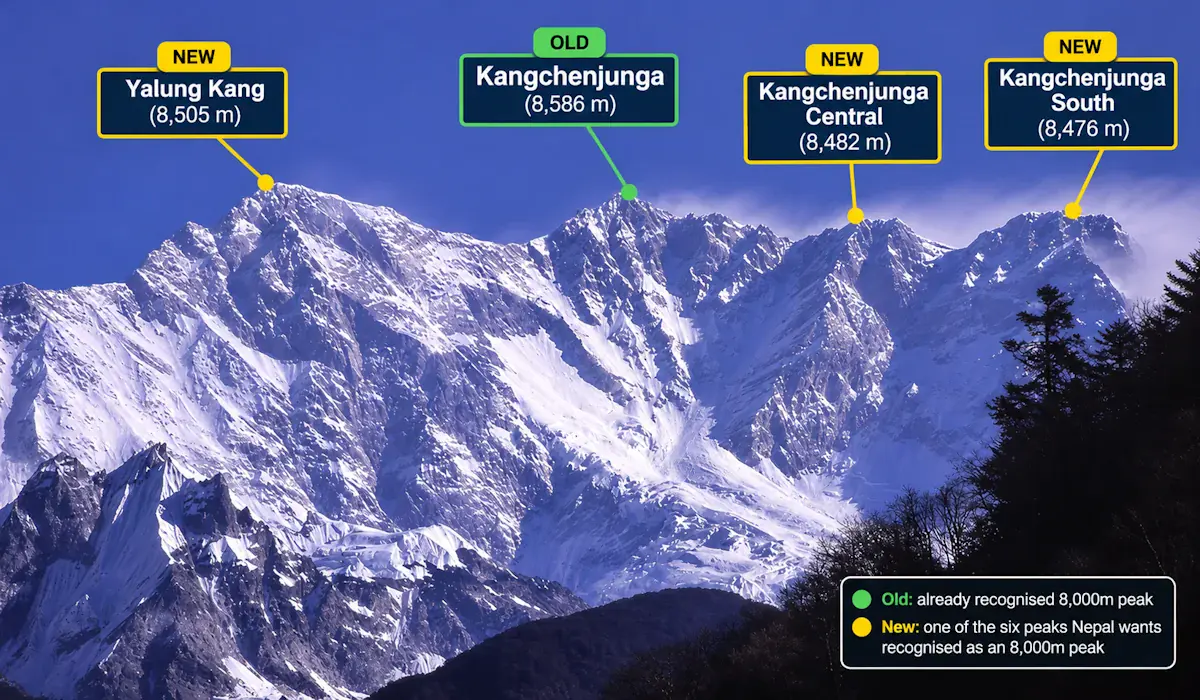
They didn’t come from anywhere. All six have been there all along: they are high summits on Kangchenjunga and Lhotse that mountaineering lists have always counted as part of those two mountains, not as mountains in their own right. In October 2026 Nepal asked the UIAA, the international climbing federation, to change that and recognise each of the six as a separate 8,000m peak.
If the UIAA agrees, the world’s list of 8,000m peaks grows from 14 to 20, and Nepal’s share from 8 to 14. Below: which six peaks, why they were never counted, and what it changes for climbers and trekkers.
Where it stands
- Internationally recognised today: 8 peaks above 8,000m in Nepal, 14 worldwide.
- Nepal’s own records: 14 peaks above 8,000m, since the Department of Tourism revised its list in 2025.
- Status: proposal submitted to the UIAA; no decision or timeline announced.
Interactive Trek Finder
Which of Nepal’s 14 top treks fits you? Filter by duration, difficulty, altitude & culture.
The 8 internationally recognised 8,000m peaks in Nepal
Everest, Kangchenjunga, Lhotse, Makalu, Cho Oyu, Dhaulagiri I, Manaslu and Annapurna I. Several of these lie on the border with China (Tibet), and Kangchenjunga on the border with India. The other six of the world’s 14 are in Pakistan and Tibet.
The six peaks Nepal wants recognised
All six are high summits on the same massifs as two existing 8,000ers: four on Kangchenjunga in far-eastern Nepal and two on Lhotse, next to Everest.
| Peak | Height | Massif |
|---|---|---|
| Yalung Kang (Yalung Khang) | 8,505 m | Kangchenjunga |
| Kangchenjunga South | 8,476 m | Kangchenjunga |
| Kangchenjunga Central | 8,482 m | Kangchenjunga |
| Lhotse Middle (also called Lhotse Central) | 8,410 m | Everest–Lhotse |
| Lhotse Shar | 8,400 m | Everest–Lhotse |
| Yalung Kang West (also reported as Kangchenjunga West) | 8,077 m | Kangchenjunga |
Heights as presented by the Nepal Mountaineering Association, October 2026, except Kangchenjunga Central (widely cited figure; the NMA gives 8,473 m).
For comparison, the main summits of these massifs are Kangchenjunga at 8,586 m and Lhotse at 8,516 m.
Who made the proposal, and where
The proposal was presented by the Nepal Mountaineering Association (NMA), led by president Phur Gelje Sherpa, together with Tourism Minister Khadga Raj Paudel. It was made at the UIAA General Assembly, which Nepal hosted in Kathmandu at the end of October 2026. Nepal last hosted the assembly in 2011, and before that in 1982.
A study team led by Madhu Sudan Adhikari prepared the technical case. The NMA argues that each of the six peaks has its own local name, a separate summit and its own climbing route, and should therefore be assessed as an independent mountain. In the NMA’s words, climbing one summit does not mean reaching another.
Why these peaks were never counted before
The list of 14 eight-thousanders is a convention, not a law. Mountaineering lists have always treated summits like Lhotse Shar and Yalung Kang as subsidiary tops of a larger mountain, because they are joined to the main summit by high ridges. Whether a summit counts as a separate mountain depends on how independent it is from its neighbour, mainly how far you have to descend before climbing again. There is no single agreed threshold, which is why Nepal is seeking international consensus rather than simply declaring the change.
Nepal’s former mountaineering leaders raised the issue repeatedly over the years without result. The NMA has now asked the UIAA executive board to formally assess the six peaks.

In Kathmandu today or tomorrow? 50% off
Last-minute seats on our small-group tours · From $7.50 per person
What changes for climbers and trekkers
For now, nothing practical. The six summits are already open for climbing under Nepal’s own rules, and no change to permits or royalties has been announced in connection with the proposal. For current fees, see our overview of Nepal entrance fees and trekking permits, and for the licensed-guide requirement and TIMS, see do you need a guide to trek in Nepal.
If the UIAA does accept the peaks, the main effects would be:
- The “14 eight-thousanders” benchmark would no longer match the official count. How record lists and climbers treat the new summits would be up to the mountaineering community.
- Nepal’s share would rise from 8 of 14 to 14 of 20, which the government sees as an opportunity for mountaineering, research and tourism promotion.
- Kangchenjunga and the Everest–Lhotse area would each gain recognised 8,000m objectives on routes that are already established. Lhotse Middle and Lhotse Shar are in the same region as the Everest Base Camp trek.
We will update this page once the UIAA responds.

Frequently asked questions
How many 8,000m peaks are in Nepal?
Eight are internationally recognised. Nepal’s national records list 14, and Nepal has asked the UIAA to recognise the extra six.
How many 8,000m peaks are there in the world?
Fourteen are internationally recognised. If all six of Nepal’s proposed peaks are accepted, the total would become 20.
Has the UIAA accepted the six new peaks?
Not yet. The proposal was presented in October 2026 and no decision or timeline has been announced.
Can you see these peaks from Kathmandu?
No. Kangchenjunga is in far-eastern Nepal and Lhotse is in the Everest region, both well beyond view from the Kathmandu Valley. For high Himalayan views without a multi-day trek, see Himalayan views you can reach by car, or take a day hike to Nagarjun, Kakani or Dhulikhel.
How do trekkers reach the Everest and Kangchenjunga regions?
Most start in Kathmandu and continue by domestic flight or by road. For a comparison of domestic carriers, see which Nepalese airline to choose. Flying in from Europe? Read why there are no direct flights from Europe yet.
Planning a trek or climb in Nepal
- Nepal Trek Finder: compare 14 top treks
- Everest Base Camp trek
- Ghorepani Poon Hill trek
- Annapurna Circuit trekking in 2026
- Nepal trekking guide rules and TIMS permits
- Nepal entrance fees and trekking permits
- Kathmandu travel tips: safety, weather and culture
- Kathmandu travel cost: what to budget
- What to do in Kathmandu in 2 days
- Send us your travel plans
A few days in Kathmandu before or after your trek?
Our guides run walking tours to the Monkey Temple, Kathmandu Durbar Square, Pashupatinath and Boudhanath and Patan, or all three valley highlights in one day on our Patan, Pashupatinath & Boudhanath tour. Small group or private, daily from Thamel.
Sources: The Kathmandu Post, The Himalayan Times, Onlinekhabar, Nepal News.