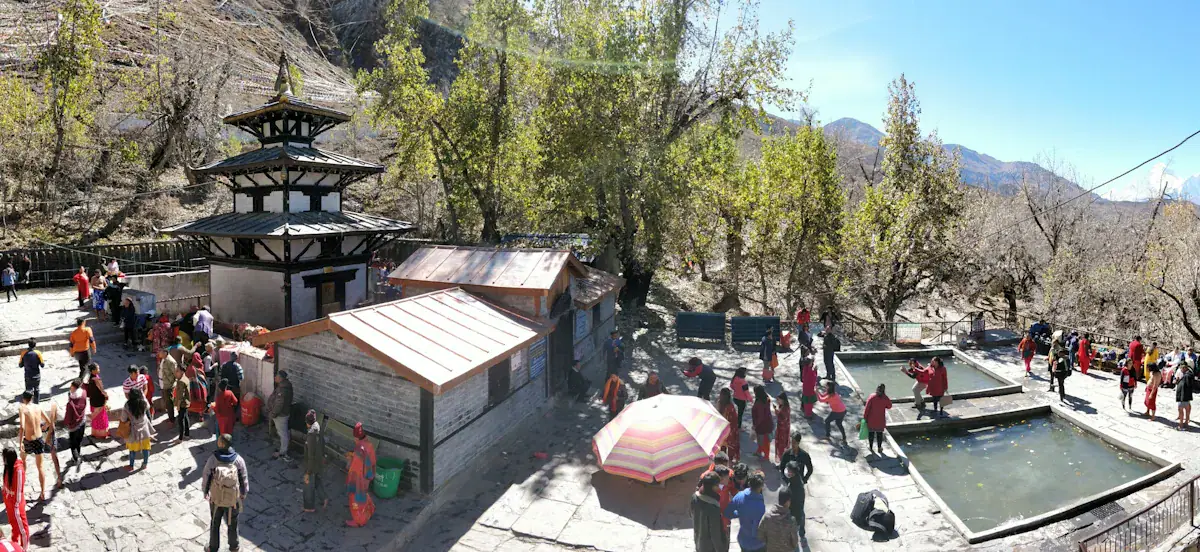
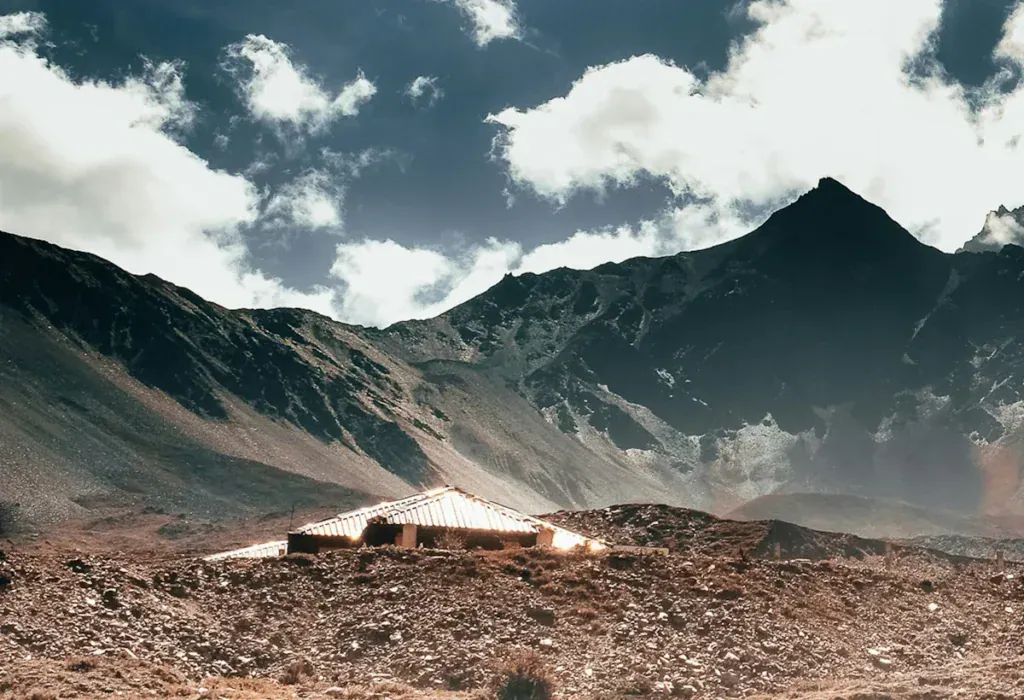
Muktinath is one of the most sacred temples in the Himalayas. It sits at 3,710 m in Lower Mustang, beyond the main Himalayan range, and the trip there is half the reward. From Pokhara you fly or drive up the Kali Gandaki gorge, between Dhaulagiri and the Annapurnas, into a dry, wind-carved landscape that looks more like Tibet than Nepal.
In 2026 Muktinath became much busier. The Annapurna Conservation Area Project (ACAP) office in Jomsom counted 290,287 foreign visitors to Mustang from January to October 2026. That is far more than the 161,141 counted in all of 2025. Of the 2026 visitors, 262,012 came from SAARC countries, mostly Indian pilgrims heading for Muktinath. Only 28,275 came from the rest of the world.
This guide covers both kinds of visitor. If you are a Western traveller, it explains what you will find, when the crowds peak and how to avoid them. If you are a pilgrim, it covers routes, permits and altitude. Either way, it takes you from Kathmandu or Pokhara to the temple steps.
Go beyond Muktinath
Ride to Lo Manthang: our Upper Mustang motorcycle tour
Muktinath is where most visitors turn back. Our guided motorcycle tour carries on north through restricted Upper Mustang to the walled city of Lo Manthang.
See the Upper Mustang tour →What Muktinath is
Muktinath is sacred to both Hindus and Buddhists, which is rare even in Nepal. Hindus worship Vishnu here as the god of liberation (mukti means liberation). Tibetan Buddhists call the site Chumig Gyatsa, “hundred waters”, and link it to Guru Rinpoche.
What you will see:
- The 108 water spouts. Cold spring water pours from 108 bull-head spouts around the pagoda-style temple. Pilgrims run through all of them, then dip in two small pools in front of the shrine. Many Western visitors watch; some join in.
- The eternal flame. In a small temple nearby, a natural gas vent keeps a flame burning beside spring water. Hindus revere it as Jwala Mai, and the image of “fire on water” is what makes the site holy to many visitors.
- The village of Ranipauwa. This is where the road ends and the hotels are. The temple is a short, steep walk uphill, about 20 minutes.
- Mountain views. On a clear morning you see the snow peaks of Dhaulagiri and Nilgiri across the valley, with the Thorong La pass rising behind the temple.
Etiquette. Dress modestly, remove shoes where signs ask, and walk clockwise around shrines and stupas. Ask before photographing pilgrims, especially at the bathing spouts. Rules are posted at the temple and change, so follow them on site.
Why Western visitors go
Most Western visitors come for Mustang rather than for the temple alone. Pilgrims usually drive up, visit the temple and head back. Western travellers tend to stay a few days and explore Lower Mustang.
- Kagbeni. A medieval mud-brick village where the Kali Gandaki meets the Jhong river, with a red monastery and narrow alleys. It is the gateway to restricted Upper Mustang.
- Jomsom and Marpha. Jomsom is the district hub with the airstrip. Marpha, a short drive south, is a whitewashed Thakali village famous for apples and apple brandy.
- The Kali Gandaki gorge. Often called one of the deepest gorges on Earth. The drive or flight passes between Dhaulagiri and the Annapurnas.
- Two religions side by side. Hindu sadhus and Indian families share the same paths as Tibetan Buddhist monks and prayer flags.
- Trekking links. Muktinath is the first village after the Thorong La pass on the Annapurna Circuit, so trekkers end up here too. You can also walk short sections of the old trail between Muktinath, Jharkot and Kagbeni.
- Shaligrams. Black ammonite fossils from the Kali Gandaki are sacred to Hindus as symbols of Vishnu. You will see them sold everywhere. Check the export rules before buying, and never take them from the riverbed in protected areas.
The pilgrim crowds: when it is busiest
May and June are by far the busiest months at Muktinath. June 2026 alone brought 80,253 foreign visitors to Mustang, and more than 95% of them were Indian. In January 2026 the figure was 10,822.
| Period (2026) | Foreign visitors to Mustang | Average per month | Visitors from outside SAARC |
|---|---|---|---|
| January | 10,822 | 10,822 | 777 |
| February–March | 32,243* | ~16,100 | 4,290* |
| April | 33,680* | 33,680 | – |
| May | 65,994 | 65,994 | 4,196 |
| June | 80,253 | 80,253 | 1,583 |
| July–October | 67,295* | ~16,800 | – |
Derived by subtracting the published monthly figures from the published cumulative totals (ACAP data, as reported in the Nepali press). Published totals differ slightly between outlets. Autumn 2026 was unusually quiet because floods closed the Beni–Jomsom road for nearly two weeks.
What the crowds mean for a Western visitor
- Roads and jeeps. About half of Indian pilgrims drive their own vehicles from India. In peak season the road from Beni to Muktinath carries heavy traffic, and jeep seats from Jomsom go fast.
- Short stays, busy temple. Most pilgrims visit the shrine and leave again quickly. Many arrive on a same-day jeep from Jomsom. Staying overnight in Ranipauwa lets you reach the temple early in the morning, before the day-trippers.
- Hotels. Ranipauwa’s guesthouses fill up in May and June. Book ahead or stay in Jomsom, Kagbeni or Marpha and visit Muktinath as a day trip.
- A different atmosphere. Peak season feels like a festival: chanting, bells, families in their best clothes. Some visitors love it. If you want quiet, avoid May and June.
Quieter months. Western visitors are spread more evenly through the year. Visitors from outside SAARC peaked at 4,196 in May and fell to 1,583 in June. Spring (March–April) and autumn (October–November) give clear views with fewer pilgrims than the May–June peak.
How to get to Muktinath from Kathmandu and Pokhara
Every route goes through Pokhara. From there you either fly to Jomsom and take a jeep, or drive the whole way up the Kali Gandaki valley.
Kathmandu to Pokhara. Fly in about 25 minutes, or drive 6–7 hours by tourist bus or private car. See our guide to getting from Kathmandu to Pokhara.
| Route from Pokhara | Time | Good to know |
|---|---|---|
| Flight to Jomsom + jeep to Ranipauwa | ~20 min flight + ~1.5 h jeep | Morning flights only, often delayed by wind or cloud. Small Twin Otter aircraft. |
| Jeep to Jomsom (via Beni and Tatopani), then on to Muktinath | 8–10 h to Jomsom | Rough, dusty road with landslide sections. Spectacular gorge scenery. |
| Direct jeep Pokhara → Muktinath | 10–12 h | The usual choice for pilgrims. Most break the trip in Jomsom or Kagbeni. |
| Helicopter charter | Fastest | The fastest option, and the most expensive. Often booked as a same-day pilgrimage. |
Status in November 2026. Scheduled Pokhara–Jomsom flights are suspended. Tara Air stopped on 19 October and Summit Air on 21 October 2026. The airlines cited falling demand after the floods and aircraft maintenance. Reports differ on how long the break lasts: “until the next season” or about five months. Charter flights and helicopters still operate. The Beni–Jomsom road reopened on 9 October 2026 after flood damage, but police said in mid-October that traffic had not yet returned to normal. Check the latest before you book.
From India. Many Indian pilgrims cross at the Sunauli–Bhairahawa border and drive north via Pokhara and Beni, or fly into Gautam Buddha International Airport at Bhairahawa.
Our tip. Allow a buffer day at each end. Jomsom flights are cancelled often, and roads close after heavy rain. Spending a night or two in Jomsom, Marpha or Kagbeni also helps you adjust to the altitude.
Flights cancelled, roads closed?
Let our Kathmandu team plan the route for you
Jomsom flights and the Beni road change with the seasons. Tell us your dates and we’ll build a Kathmandu – Pokhara – Muktinath plan that works.
Plan my trip → WhatsApp us Hotels in PokharaPermits, altitude and practical tips
You need one permit for Muktinath: the Annapurna Conservation Area Permit (ACAP). Muktinath, Jomsom, Kagbeni and Marpha all lie inside the Annapurna Conservation Area.
| Visitor | ACAP fee per person per entry |
|---|---|
| Non-SAARC foreigners (Europe, Americas, Australia etc.) | NPR 3,000 |
| SAARC nationals, including Indian citizens | NPR 1,000 |
| Nepali citizens | NPR 100 |
| Children under 10 | Free |
- Where to get it. See all current fees on our Nepal entrance fees and trekking permits page. Get it online through the NTNC ePermit system, at the Nepal Tourism Board office in Kathmandu (Pradarshani Marg), or at the Tourist Service Centre in Pokhara (Damside). Carry it with you, because it is checked on the road.
- TIMS card. The standard Jomsom–Muktinath route is not listed by NTB as a mandatory TIMS route. If you add a trek that is on NTB’s list, the TIMS fee is NPR 2,000 for non-SAARC foreigners and NPR 1,000 for SAARC nationals. See our TIMS and guide explainer.
- Upper Mustang is different. North of Kagbeni you enter restricted Upper Mustang (Lo Manthang), which needs a separate, more expensive restricted-area permit and a licensed guide. Muktinath itself does not need it.
Altitude. At 3,710 m, Muktinath is high enough for altitude sickness, especially if you drive up from Pokhara (about 820 m) in one day. Sleep lower the first night if you can, in Jomsom or Kagbeni. Walk slowly up to the temple, drink plenty of water and go back down if you get a severe headache, vomiting or confusion. Older pilgrims and anyone with heart or lung conditions should ask a doctor before going.
Practical tips
- Wind and cold. Strong afternoon winds blow up the Kali Gandaki valley almost every day. Mornings are calmer. Bring a windproof jacket, sunglasses and a buff against dust, even in summer. Nights are cold from October to March.
- Cash. Bring enough Nepali rupees. ATMs in Jomsom can be unreliable, and many guesthouses and jeep drivers take cash only.
- Bathing at the spouts. If you plan to bathe, bring a change of clothes and a towel. The water is icy.
- Food. Ranipauwa and Jomsom have simple lodges with dal bhat, Thakali dishes and vegetarian food. Many places near the temple serve vegetarian food only.
Want to walk instead?
Compare 14 Nepal treks in one minute
The Annapurna Circuit crosses the Thorong La and comes down into Muktinath. Our free Trek Finder compares it with 13 other treks by days, altitude and difficulty.
Open the Trek Finder → All permit feesBest time to visit Muktinath
For Western visitors, the best times are March–April and October–November: clear skies, manageable cold and fewer pilgrims than in the May–June peak.
| Months | Weather and access | Crowds |
|---|---|---|
| March–April | Clear, cool, windy in the afternoons. Flights and roads normally running. | Moderate, rising in April |
| May–June | Warm days, still dry in Mustang. | Peak pilgrim season, busiest by far |
| July–September | Mustang lies in a rain shadow, but the monsoon causes landslides and floods on the Beni road. Flights have been suspended in some summers. | Lower |
| October–November | Clearest mountain views, cold nights. | Moderate |
| December–February | Very cold, with snow possible at Muktinath. Scheduled flights have stopped in recent winters. | Quiet |
Flight schedules to Jomsom are seasonal and change every year. In 2025–26, scheduled flights paused over the winter (from December to early March) and again from late May for about three months. They paused once more in October 2026. Always check before you plan around a flight.
Sample itineraries
Pilgrim’s quick route (3 days from Pokhara, by jeep)
- Pokhara → Jomsom or Kagbeni by jeep (8–10 h). Overnight there to adjust to the altitude.
- Early jeep to Ranipauwa, temple visit and bath at the 108 spouts, then back to Jomsom.
- Jomsom → Pokhara by jeep.
Traveller’s Lower Mustang loop (5–6 days from Pokhara)
- Pokhara → Jomsom (flight if running, otherwise jeep). Walk to Marpha.
- Jomsom → Kagbeni. Explore the old village and the monastery.
- Kagbeni → Muktinath, by jeep or on foot via Jharkot (a steady climb of roughly 900 m). Overnight in Ranipauwa.
- Sunrise at the temple, then down to Jomsom.
- Jomsom → Pokhara.
- Buffer day for cancelled flights or road closures.
Starting in Kathmandu? Spend a day or two in the Kathmandu Valley before you head west. Pashupatinath, Nepal’s holiest Hindu temple, is a natural first stop for pilgrims. Read how to visit Pashupatinath respectfully, or book a private guide for Kathmandu’s temples before your trip to Mustang.
Start your pilgrimage in Kathmandu
Pashupatinath and the evening Aarati, with a local guide
Visit Nepal’s holiest Hindu temple before you head to Muktinath. Our guides explain the rituals, the cremation ghats and the evening Aarati ceremony.
Pashupatinath & Aarati tour → Pashupatinath + BoudhanathMuktinath FAQ
How high is Muktinath? 3,710 m (12,172 ft), according to most sources. Some guides give about 3,800 m.
Can I visit Muktinath without trekking? Yes. A jeep road runs all the way to Ranipauwa, and the temple is a 20-minute walk from there.
Do I need a guide? Not for Muktinath and Lower Mustang by road. Upper Mustang requires a licensed guide.
Can non-Hindus enter Muktinath Temple? Yes. Visitors of all faiths can walk the temple grounds and watch the rituals. Follow any signs at the inner shrine.
How many days do I need? At least 3 days from Pokhara, or 5–6 to explore Lower Mustang without rushing.
When is it least crowded? Avoid May and June. December to February is the quietest but very cold. March–April and October–November balance views and crowds.
Combine Muktinath with the best of Nepal
Kathmandu’s temples, Pokhara’s lakeside and the mountains, on a private round trip planned around your dates.
11-day Nepal Highlights → All round trips Talk to usSources
- 290,287 tourists visit Mustang in 10 months — Onlinekhabar, 3 Nov 2026
- Mustang Sees 77.62% Tourist Increase — Ratopati, 3 Nov 2026
- Mustang records surge in tourist arrivals — Khabarhub, 3 Nov 2026
- 80,253 foreign tourists enter Mustang in June — Nepal News, 3 Jul 2026
- Over 10,000 foreign tourists visit Mustang in January — The Annapurna Express, 3 Feb 2026
- Mustang sees surge in first quarter of 2026 — Ratopati, 2 Apr 2026
- Tourist arrivals in Mustang plunge 41.5 percent — The Kathmandu Post, 19 Oct 2026
- Pokhara–Jomsom–Pokhara flights to be suspended from Wednesday — People’s Review, 17 Oct 2026
- Tourism entrepreneurs concerned at suspension of Jomsom flights — HimalPress, 19 Oct 2026
- Pokhara-Jomsom air services suspended for five months — Nepal News, 22 Oct 2026
- Pokhara–Jomsom regular flights suspended — Nepal News, 3 Jun 2026
- Pokhara–Jomsom flights suspended for winter — Tourism Info Nepal, 25 Dec 2025; flights resume, 10 Mar 2026
- Beni-Jomsom route reopens — Nepal News, 11 Oct 2026
- Lower Mustang permit cost breakdown — Hop Nepal (operator blog), updated 3 Nov 2026: ACAP and TIMS fees, permit offices
- Muktinath tour guide — Majestic Trails (operator blog), 22 Feb 2026: altitude, travel times
Main photo; Muktinath Temple with its 108 water spouts and two holy pools, Lower Mustang. Photo: Nipendramaharjan / Wikimedia Commons